Few things are more frustrating than putting on your swim cap, starting your swim, and then feeling it slowly work its way backward—or suddenly pop off altogether.
A slipping cap does not always mean the cap itself is the problem. Fit, hair placement, positioning, cap material, and the condition of the cap can all affect how securely it stays in place.
Here are nine common reasons a swim cap slips, along with practical ways to troubleshoot each one.
Why Does My Swim Cap Keep Slipping Off?
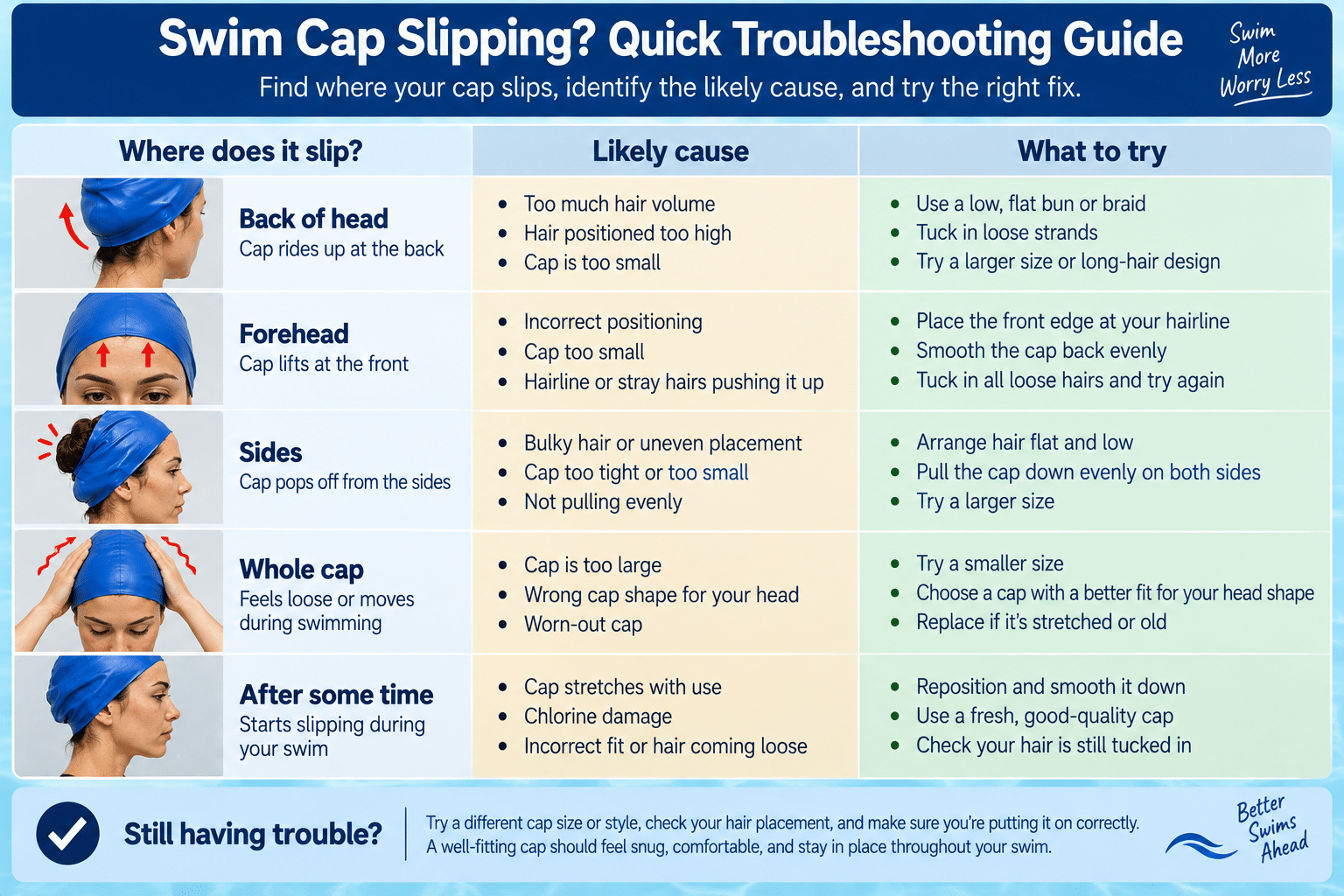
The easiest way to diagnose the problem is to notice where the cap starts moving. A cap that rides up at the back may have a different cause from one that lifts at the forehead or comes loose around the sides.
| What you’re experiencing | Possible cause |
|---|---|
| Rides up at the back | Hair volume, hair placement, or fit |
| Lifts at the forehead | Positioning or excessive tension |
| Pops off around the sides | Uneven fit or bulky hair |
| Feels loose everywhere | Size, shape, or worn material |
| Starts slipping after several months | Stretching or wear |
9 Reasons Your Swim Cap Keeps Slipping
1. Your swim cap is the wrong size
A cap that is too large can move around because there is not enough tension to hold it securely. But going too small is not automatically the answer. Excessive tension can make a cap uncomfortable and can cause it to ride upward as it stretches over the head.
The goal is a snug, comfortable fit without excessive pressure.
2. Your hair is creating an uneven shape underneath the cap
Long, thick, or curly hair can change the shape of the head underneath a cap. If most of the hair is gathered into a large lump at the crown or back, the cap may be pushed upward as you swim.
Try arranging the hair into a compact shape that sits closer to the head before putting the cap on.
3. You’re putting the cap on incorrectly
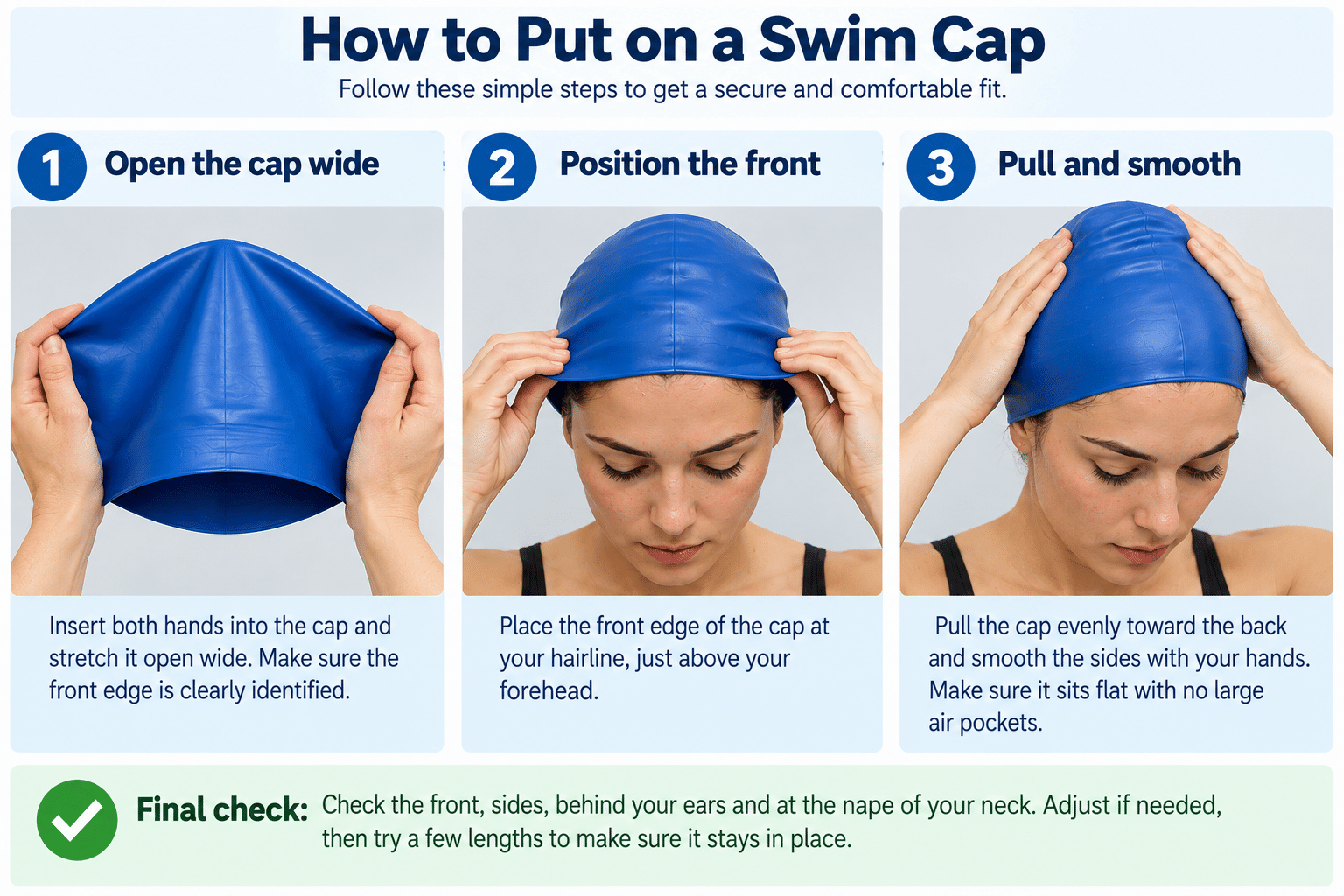
Positioning matters. U.S. Masters Swimming recommends paying attention to the cap seam and keeping the front of the cap in an appropriate position on the forehead. It also notes that wetting the hair first can make application easier for some swimmers.
A simple approach is to open the cap with both hands, position the front edge, then pull it evenly toward the back while smoothing the sides.
4. Your hair or skin has too much slippery product on it
Hair products can change how the cap feels and moves. If you regularly use conditioner, oils, or styling products before swimming, experiment with your routine and see whether the cap behaves differently.
This is not a universal rule: some swimmers deliberately use conditioner before putting on a cap, so treat it as a troubleshooting variable rather than a guaranteed cause.
5. The cap material may not suit your needs
Swim caps are made from different materials, including silicone, latex, and fabric. They do not all behave the same way. U.S. Masters Swimming notes that different materials have different functional characteristics and that swimmers may prefer different styles depending on their needs.
If one material repeatedly moves on your head, trying another type can be a useful experiment.
6. Your cap doesn’t have enough room for your hair volume
Head circumference is not the only consideration. A swimmer with long or thick hair may need additional room inside the cap to accommodate the hair without creating a large pressure point.
Some long-hair swim caps are specifically designed with extra space for tucking hair inside.
7. The cap isn’t sitting correctly around your hairline
Check the entire rim after putting the cap on. Look at the forehead, temples, area behind the ears, and nape of the neck.
A folded or uneven rim can create an unstable fit. Smooth the cap with your hands and make sure loose strands of hair are tucked inside rather than caught underneath the edge.
8. You’re trapping too much air inside the cap
A large air pocket can make a cap feel unstable, particularly when you push off the wall, turn, dive, or swim at higher speeds. After putting the cap on, smooth it gently from front to back and from the sides toward the crown to reduce obvious pockets and folds.
9. Your swim cap is stretched or worn out
Swim caps do not last forever. Repeated stretching, chlorine exposure, storage conditions, and normal use can eventually affect the material.
If your cap used to stay securely in place but now feels noticeably looser, has a distorted rim, or shows visible damage, wear may be the reason it keeps slipping.
How to Stop Your Swim Cap From Slipping
Try this checklist before replacing your cap:
- Wet your hair if that makes your cap easier to put on.
- Arrange long or thick hair into a compact, low shape.
- Open the cap fully with both hands.
- Position the front edge and seam correctly.
- Pull the cap evenly toward the back.
- Smooth the sides and check around the ears and nape.
- Swim a few lengths and notice exactly where it begins to move.
That last step is useful: the location of the movement can point you toward the underlying problem.
What If Your Swim Cap Keeps Slipping With Long Hair?
Long hair can make cap fitting more difficult because there is simply more hair to accommodate. U.S. Masters Swimming recommends pulling long hair back before putting the cap on, while some long-hair caps are designed with additional space for tucking hair inside.
Experiment with a low bun, braid, or another compact arrangement rather than creating a large high bun. The objective is to distribute the hair so it does not create a large bump that pushes the cap upward.
Does a Silicone Swim Cap Slip Less Than Latex?
There is no universal answer. Silicone and latex have different properties, and the way a cap feels on your head depends on the particular design, fit, hair type, and swimming activity.
If your current cap repeatedly slips, changing material can be worth testing—but first check the size and how you are putting it on.
When Should You Replace Your Swim Cap?
Consider replacing a cap when you can see signs of significant wear or when its fit has changed noticeably. A stretched rim, tears, thinning material, or a cap that repeatedly moves despite correct positioning can all be reasons to try a fresh one.
Frequently Asked Questions
Why does my swim cap keep slipping off?
The most common possibilities include incorrect fit, hair volume or placement, uneven positioning, unsuitable material, and normal wear. Start by identifying where the cap moves.
Why does my swim cap keep riding up at the back?
Hair volume or a high hairstyle can push the cap upward. A loose fit can also contribute. Try a flatter hair arrangement and check the cap’s size.
How do I stop my swim cap from slipping with long hair?
Arrange the hair into a compact shape close to the head, tuck loose strands inside, and consider a cap designed to accommodate additional hair volume.
Does wetting your hair make a swim cap stay on better?
Wetting your hair can make some caps easier to put on and can reduce pulling on dry hair. It does not guarantee that a cap will stay in place, however.
Do silicone swim caps slip less than latex?
Not necessarily. Material affects how a cap behaves, but fit, design, hair placement, and application technique also matter.
Can a swim cap be too tight and still slip?
Yes. A cap that is excessively tight can create high tension and may ride upward rather than staying comfortably in position. The goal is a snug fit without excessive pressure.
The Bottom Line
A swim cap that keeps slipping does not necessarily mean you need a completely different cap. Start with the basics: check the fit, flatten and organize your hair, position the cap carefully, and inspect the rim and material for signs of wear.
If your main goal is keeping your hair as dry as possible, you can also see our guide to keeping your hair dry while swimming.
For more information about how SwimmingHQ evaluates swimming gear, see our review methodology and testing process.