Putting on a swim cap should take a few seconds. If it routinely pulls your hair, catches at the hairline, or feels impossible to stretch over your head, the problem is usually the technique, the way your hair is prepared, the cap material, or the cap’s size and shape—not that you need to force it into place.
This guide shows a practical way to put on a silicone or latex swim cap with less pulling and fewer snags. It also covers long and thick hair, what to do when the cap keeps grabbing individual strands, and when changing the cap is a better solution than changing your technique.
The Short Version: The Least-Pulling Way to Put On a Swim Cap
- Remove sharp hair accessories. Take out clips, pins and anything with an exposed edge that could catch the cap.
- Wet your hair first. Fresh water makes the hair easier to manage and is also recommended by U.S. Masters Swimming before putting on a cap.
- Gather long hair close to your head. Use a soft hair tie and make a compact bun, coil or low-profile bundle rather than leaving a ponytail sticking straight out.
- Open the cap with both hands. Put your hands inside the cap and stretch the opening wide with your fingers and palms.
- Place the front edge first. Set the front of the cap where you want it on your forehead, then bring the sides and back over your hair.
- Use your fingertips, not your fingernails. If a section needs adjusting, move the material with the pads of your fingers.
- Tuck in loose hair last. Do not repeatedly yank the cap backward to catch individual strands.
The key idea is simple: stretch the cap away from your hair before placing it over your head. Trying to pull a narrow opening across dry hair is what creates many of the painful little tugs swimmers notice.
Why Swim Caps Pull Hair
Swim caps are designed to fit closely against the head, and some materials grip hair more than others. Latex is particularly prone to sticking to dry strands, while silicone is generally smoother and easier to handle. U.S. Masters Swimming specifically recommends wetting the hair first because some cap materials can stick to dry hair.
Hair pulling can also happen because the cap is being stretched in the wrong direction. If you grab a small section of the rim and drag it across your hair, the edge can catch individual strands. The same thing happens when you repeatedly pull the cap down after it has already caught hair.
| What you notice | Likely reason | First thing to try |
|---|---|---|
| Individual hairs get caught at the front | Dry hair or a narrow opening | Wet hair and stretch the cap wider before placing it |
| Long hair gets trapped at the back | Hair is sticking out or has too much bulk | Gather the hair into a compact shape first |
| The cap pulls whenever you adjust it | Fingernails or small sections of the rim are catching hair | Use finger pads and move larger sections of material |
| The cap feels painfully tight | Wrong size, shape or material | Try a larger or long-hair cap instead of forcing it |
Step 1: Prepare Your Hair Before Touching the Cap
Preparation makes the biggest difference for swimmers with long, thick, curly or textured hair.
Start by rinsing your hair with fresh water. Your hair will be easier to organize when it is damp, and this also follows the general pre-swim practice recommended by swimming organizations and manufacturers. Speedo’s current hair-care guidance also recommends wetting the hair and says conditioner can make the cap easier to put on for swimmers who find that hair pulls.
If you use conditioner, keep the amount modest and follow your pool’s rules. You do not need to saturate your hair with product just to put on a cap.
For short hair
Brush or smooth the hair backward with your hands. You are aiming for an even surface rather than perfect styling.
For long hair
Gather the hair close to the head. A compact bun or coil is easier to cover than a ponytail extending straight backward. The exact position depends on your cap’s depth: the goal is to avoid creating one large lump that forces the cap to stretch excessively.
For thick, curly, braided or high-volume hair
Do not try to compress all the hair into a standard cap by brute force. A deeper or long-hair cap can give you more room and reduce the amount of stretching required. U.S. Masters Swimming notes that some caps are available in larger sizes for swimmers with longer hair.
Step 2: Open the Cap Properly
Hold the cap with both hands inside the opening. Separate your hands so the opening becomes as wide as you can comfortably make it.
Do not pinch the rim into a tiny loop and try to pull that loop over your forehead. That concentrates the tension into a small area and makes it much easier for the edge to catch hair.
For silicone caps, use the broad pads of your fingers and palms. Avoid digging your fingernails into the material. Fingernails can damage a cap as well as snag hair. SwimOutlet’s cap-care guidance similarly recommends using fingertips rather than fingernails when adjusting a cap.
Step 3: Put the Front Edge in Position First
With the cap stretched open, place the front edge against your forehead or hairline, depending on the fit you want.
Then bring the cap backward over the top of your head while keeping both sides reasonably wide. You are not trying to stretch the cap from one tiny point. You are distributing the stretch across the whole opening.
For a cap with a center seam, U.S. Masters Swimming recommends aligning the seam from the middle of the forehead toward the nape of the neck. That gives you a useful visual reference while positioning the cap.
Step 4: Bring the Sides and Back Over Your Hair
Once the front is positioned, gradually work the sides toward the back. Keep the cap opening broad as you move it rather than pulling one corner down at a time.
If you feel a sharp tug, stop. Do not keep pulling. Lift that section slightly, free the trapped hair with your fingertips, and continue.
This is also where swimmers with long hair often make a common mistake: they keep pulling the cap farther down because some hair is still outside. If the cap is already stretched tightly, that extra pulling can create more hair tension without actually creating enough room for the remaining hair.
Step 5: Tuck Loose Hair Into the Cap
After the main part of the cap is in place, use your fingertips to tuck loose strands underneath the edge.
Work around the head in small sections. Do not hook a fingernail under the cap and drag it along the scalp. That can catch hair and can also weaken thin latex material.
If you have a lot of hair outside the cap, stop and reassess the setup rather than repeatedly stuffing it in. You may need a deeper cap or a different hairstyle underneath.
The Best Technique for Long Hair
For long hair, the most reliable sequence is usually:
| Stage | What to do | Why it helps |
|---|---|---|
| 1. Wet | Rinse hair with fresh water | Makes the hair easier to organize and can reduce sticking |
| 2. Gather | Bring hair close to the head | Creates a smaller, more manageable profile |
| 3. Secure | Use a soft tie if needed | Keeps the hair together while the cap goes on |
| 4. Open | Stretch the cap wide with both hands | Reduces concentrated pulling on individual strands |
| 5. Place | Front edge first, then sides and back | Lets the cap move over the hair instead of dragging across it |
| 6. Tuck | Use fingertips to put remaining strands inside | Avoids repeated hard pulling on the rim |
For very long or high-volume hair, an oversized or long-hair cap can be a more meaningful improvement than learning a more aggressive technique. A cap should contain the hair without requiring you to compress it painfully.
Should You Wet the Cap Before Putting It On?
There is no single rule for every cap. The more important step is wetting your hair. U.S. Masters Swimming notes that swimmers sometimes wet the cap itself, but that the appropriate approach can depend on the material.
If your manufacturer gives specific instructions, follow those instructions. For a silicone cap, you generally want enough control to open and position the cap without it folding onto itself.
Silicone vs. Latex: Which Is Easier on Hair?
Material changes how a cap feels during installation.
| Cap material | Typical feel when putting it on | Hair consideration |
|---|---|---|
| Silicone | Smooth, thicker and relatively easy to stretch into position | Often gentler to handle than latex because the surface is smooth |
| Latex | Thin, stretchy and more prone to gripping the hair | Wet hair can make installation easier; avoid latex if you have a latex allergy |
| Lycra / fabric | Soft and easy to pull over the head | Usually the least troublesome for hair, but it does not provide the same water barrier or hydrodynamic properties as rubberized caps |
U.S. Masters Swimming describes silicone as thicker and less elastic than latex, while Lycra-style fabric caps are easier to put on and take off without pulling hair.
What Not to Do When Putting on a Swim Cap
- Do not pull a small section of the rim across your hair. Open the cap wider first.
- Do not use your fingernails to grab the material. Use your fingertips and palms.
- Do not force a cap that is obviously too small. Excessive stretching will not turn the wrong size into a comfortable fit.
- Do not keep pulling when you feel a sharp hair tug. Stop, free the hair and reposition the cap.
- Do not put clips or sharp pins underneath the cap. They can catch hair and damage the cap.
- Do not repeatedly remove and reinstall the cap just to fix a few strands. Get the main fit right first, then tuck the remaining hair.
If the Cap Still Pulls Your Hair, Check the Fit
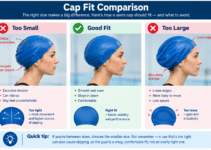
Technique cannot compensate for every fit problem. If a cap causes pain every time you put it on, leaves excessive pressure on your forehead, or cannot accommodate your hair without extreme stretching, consider changing the cap rather than pulling harder.
We have a separate guide on why swim caps slip off and how to fix the underlying causes. If your main goal is reducing water exposure to your hair, our tested guide to swim caps for keeping hair dry covers the broader fit and cap-type trade-offs. These are different problems: this article is about getting the cap onto your head with minimal hair pulling.
Can Double Capping Reduce Hair Pulling?
Adding a second cap is not a substitute for putting the first cap on correctly. In competitive swimming, double capping is commonly used for reasons such as goggle-strap security and racing setup rather than as a hair-pulling solution.
If you are considering two caps, see our guide to when double capping actually helps. For most recreational swimmers, getting one comfortable cap to fit correctly is the simpler starting point.
A 30-Second Pre-Swim Routine
If you want a repeatable routine, use this:
- Rinse your hair with fresh water.
- Remove clips and anything sharp.
- Gather long hair into a compact shape.
- Put both hands inside the cap and stretch it wide.
- Place the front edge first.
- Bring the sides and back over the head without dragging a narrow edge across the hair.
- Use fingertips to tuck stray strands inside.
- Check that the cap is snug but not painfully tight.
Once you have practiced the sequence, putting on a cap should become a controlled movement rather than a tug-of-war with your hair.
Frequently Asked Questions
Should my hair be wet before I put on a swim cap?
Yes, wetting your hair first is a commonly recommended approach. U.S. Masters Swimming recommends wetting hair before putting on a cap, and Speedo’s current guidance also recommends wetting hair as part of its pre-swim routine.
How do I put on a swim cap without pulling long hair?
Wet the hair, gather it close to the head, stretch the cap wide with both hands, place the front edge first, and bring the cap over the hair gradually. Tuck loose strands with your fingertips at the end.
Why does my latex swim cap pull my hair?
Latex can grip dry hair more readily than smoother materials. Wetting your hair and opening the cap fully before placing it on your head can reduce snagging. If it remains painful, consider whether another material or a larger cap would fit your hair better.
Can I use conditioner before putting on a swim cap?
Some swimmers use a small amount of conditioner to make the cap easier to put on, and Speedo currently recommends conditioner as an optional part of its hair-protection routine. Follow your pool’s rules and avoid using more product than necessary.
Why does my swim cap keep catching individual hairs?
Usually the cap is being pulled across the hair rather than opened wide enough first, or the hair is dry and sticking to the material. Stop when a strand catches, free it with your fingertips, and continue with a wider grip.
Should the cap cover my ears?
There is no single ear position that works for every swimmer or cap. Comfort and stability matter more than forcing the edge over the entire ear. If moving the cap around your ears creates pain or makes it unstable, the cap’s shape or size may not suit you.
Our Testing Approach
SwimmingHQ separates hands-on testing from general product research. When we evaluate swim gear, we consider fit, ease of use, durability and real-world swimming conditions rather than relying only on manufacturer descriptions. See our Testing Lab & Review Methodology for how we approach those evaluations.